

You might have picked up a coloring page and thought: this is just for children. But something quiet and surprising happens when an adult sits down with a pencil and a page of gentle lines. The noise in your head settles. Your breath slows. Time feels softer.
That feeling is not a coincidence. Researchers and therapists have been paying close attention to what happens when adults color, and what they have found is encouraging. Coloring gives your mind a quiet place to rest. And rest, it turns out, is something the brain genuinely needs.
This post walks through the science behind coloring in plain, honest language. No complicated terms. No pressure to become an artist. Just a warm look at why picking up a colored pencil might be one of the kindest things you can do for yourself today.
What Happens in Your Brain When You Color
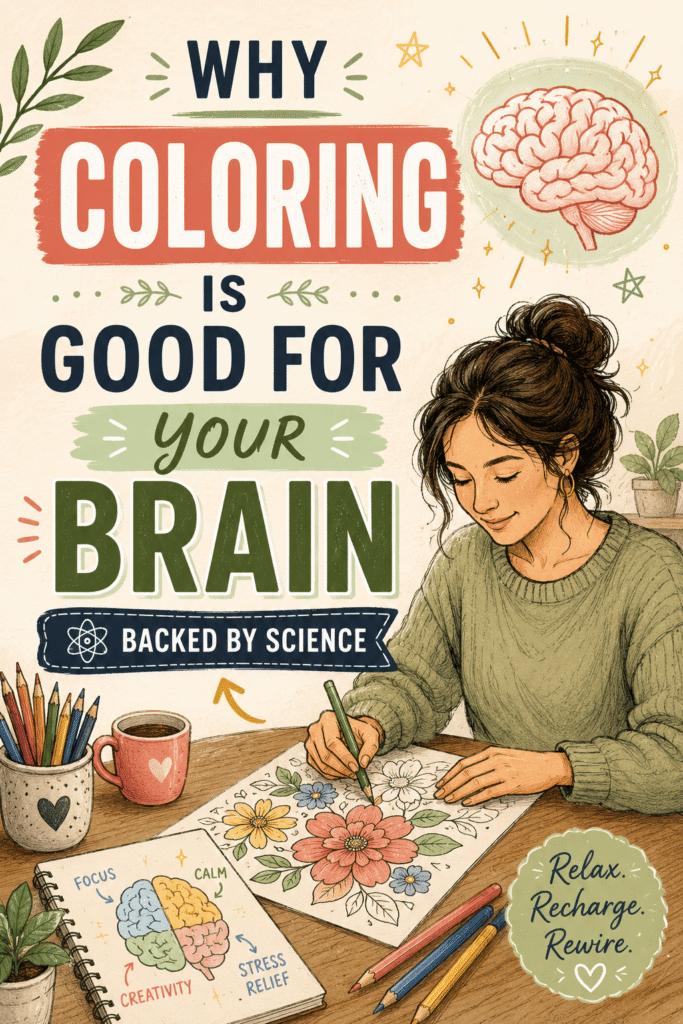
When you color, several areas of your brain become gently active at the same time. The part of your brain responsible for vision is engaged by the shapes and colors in front of you. The part that controls fine motor movement is involved as your hand moves across the page. And the part that handles focus and attention is quietly occupied, keeping your thoughts on the task at hand.
This combination is meaningful. When your attention is absorbed by a simple, pleasurable activity, your mind has less room for anxious thoughts, replaying worries, or feeling overwhelmed. Psychologists sometimes call this a state of low-level, absorbed attention. It is close to what happens when you take a peaceful walk, listen to music you love, or watch rain on a window.
Coloring is not complicated enough to feel like work. But it is just engaging enough to hold your attention. That balance is exactly what makes it restful.
How Coloring May Reduce Stress and Anxiety
Stress and anxiety often live in the part of your brain called the amygdala. This is your brain’s alert system, and it works hard. When you are worried, overwhelmed, or simply carrying too much, this system stays switched on.
Creative activities that involve gentle repetition and visual focus can help quiet that alert system. They encourage the brain to shift out of a reactive state and into something calmer. Some researchers have compared this to the mental shift that happens during guided relaxation or gentle meditation.
This is one reason people often describe coloring as unexpectedly soothing. If you have ever sat down feeling tense and risen from your chair feeling lighter, your brain’s stress response may have genuinely shifted during that time.
The benefits of coloring for adults dealing with anxiety are not dramatic or guaranteed for everyone. But for many people, the simple act of choosing colors and filling in shapes provides a real, measurable sense of relief. That is worth paying attention to.
Why Repetitive Creative Activities Feel Calming
There is a long tradition of using repetitive handwork as a form of comfort. Knitting, weaving, quilting, beadwork, and other crafts have been part of human daily life for centuries, in part because they offer something that busy, noisy life often does not: a rhythm.
Coloring fits into this same family of activities. The movement of filling in a space, stroke by stroke, has a gentle rhythm to it. Simple creative routines can feel deeply calming precisely because they give you something consistent and predictable to return to.
When life feels uncertain or overwhelming, repetitive activities offer a sense of small control. You choose the color. You fill in the space. You complete the shape. These small decisions and completions can provide genuine emotional satisfaction, even when larger things feel out of reach.
There is also something meaningful about finishing. Completing a coloring page, even a simple one, gives you a moment of quiet accomplishment. That matters more than it might seem.
Coloring and Mindfulness
Mindfulness is a word that can feel complicated, but its meaning is simple. It means being present with what you are doing, right now, without your mind drifting to the past or future. Most of us find this surprisingly difficult to do.
Coloring creates a gentle, natural invitation to be present. When you are paying attention to which color to choose, how to fill in a petal, or where one shade ends and another begins, you are here. You are not replaying yesterday’s conversation or planning tomorrow’s list.
This is why coloring is sometimes described as a mindful coloring activity even by people who would never sit down to meditate. It offers many of the same benefits, wrapped in something more familiar and more forgiving.
You do not need to call it mindfulness if that word does not suit you. You can simply call it a quiet half hour with your pencils. The result is often the same: a mind that has had a chance to breathe.
Why Easy Designs Feel Less Frustrating
Not all coloring pages feel the same. If you have ever picked up an intricate coloring book filled with tiny, detailed patterns, you may have felt more tense when you put it down than when you picked it up. That is not a failure on your part. That is design.
When lines are very fine and spaces are very small, coloring requires a level of precision that can feel demanding rather than restful. For adults with any shakiness in their hands, reduced vision, or simply less patience for fine detail, complex pages can create frustration instead of calm.
Bold, simple designs work differently. When lines are thick and spaces are generous, your hand can move more freely. There is room for your own rhythm. You are not chasing a tiny gap with the tip of your pencil. You are simply coloring, at your own pace, without worry.
The coloring therapy benefits that researchers describe tend to appear most clearly when the activity itself feels manageable. Ease is not a compromise. Ease is the point.
How Coloring Supports Healthy Aging
For older adults, coloring offers a particular combination of benefits that are worth mentioning gently and honestly.
Fine motor practice. The small, controlled movements of coloring help maintain hand dexterity and coordination. This kind of gentle practice can be meaningful for people managing arthritis or other conditions that affect hand movement.
Focused attention. Staying engaged with a visual task exercises the brain’s attention systems. Regular use of these systems, even through gentle activities, may help maintain cognitive sharpness over time.
Emotional regulation. Seniors and caregivers both frequently experience elevated stress and emotional fatigue. Having a simple, consistent activity that provides calm is genuinely useful for mental health and daily wellbeing.
A sense of purpose and accomplishment. Completing something beautiful, however small, provides a quiet satisfaction that contributes to a positive mood and a sense of meaning in daily life.
Coloring is not a medical treatment, and it is not presented here as one. But as a daily habit that is gentle, enjoyable, and genuinely supportive of mental and physical wellbeing, it has real merit.
What Researchers Have Found About Adult Coloring
Academic interest in adult coloring has grown steadily over the past decade, particularly as structured coloring books for adults became widely popular. A number of studies have looked at whether coloring produces measurable changes in mood, stress, and anxiety, and the findings have been encouraging.
Several studies found that participants who colored for a period of time before a stressful task showed lower levels of anxiety than those who did not. Others found that coloring produced measurable reductions in self-reported stress and an improvement in mood, particularly when the activity was pursued in a relaxed, unhurried way.
Some researchers have specifically compared complex mandala designs with simple patterns and found that simpler designs often produced equal or greater relaxation. This supports what many people already sense intuitively: that a page you can color without frustration is more restful than one that feels like a challenge.
The research in this area is still growing, and no study claims coloring is a cure for anything. But the consistent theme across findings is that coloring and stress relief are genuinely connected for many adults, particularly when the activity is approachable and pleasant.
Simple Ways to Start a Relaxing Coloring Routine
You do not need anything elaborate to begin. A few basic supplies and a little time is all it takes. Here are some gentle suggestions for building a coloring habit that feels good and stays with you.
- Choose a time that is already quiet. Early morning before the day begins, or in the evening after dinner, tend to work well. Pair coloring with a moment you already enjoy, like a cup of tea or a favorite piece of music in the background.
- Keep your supplies nearby. A small basket or tin with a few pencils or markers, and a printed page ready to go, removes every barrier. When your supplies are visible and accessible, you are far more likely to reach for them.
- Start with one simple page. Choose a design with generous spaces and bold lines. A single flower, a simple bird, a gentle landscape. There is no need to work through an entire book. One page, colored with care, is enough.
- Release any expectation of perfection. Coloring is not about staying inside every line. It is about the experience of doing it. There is no wrong color combination. There is only your own quiet hour with your own page.
- Let yourself be a beginner. Most adults worry they are not artistic enough to enjoy coloring. This concern is worth setting aside gently. Coloring does not ask you to be an artist. It asks you to be present. That is something you are already capable of.
- Display what you make. Even a simple finished page, taped to a refrigerator or tucked into a frame, is a small reminder that you made something. That reminder has value.
Free Printable Pages to Try
If you are curious about coloring but have not started yet, we would love to offer you a gentle place to begin. At Coloring Willow, every page is designed with bold, thick lines and open, generous spaces. They are made to feel approachable and beautiful, for seniors, for beginners, and for anyone who simply wants a moment of calm.
Our free coloring pages are a simple, no-obligation way to experience what mindful coloring activities can feel like. Download, print on any standard printer, and color at whatever pace feels right to you.
There is no right way to use them. Some people color for ten minutes on a busy afternoon. Others settle in for an hour on a slow Sunday. Either way, the pages are there whenever you need them.
You deserve a moment of calm today. Click here to get your free bold and easy coloring pages!
4 thoughts on “Why Coloring Is Good for Your Brain (Backed by Science)”