

If you have been feeling stretched thin lately, you are not alone. Life has a way of piling things on: the news, the to-do list, the worry that follows you from room to room. And in the middle of all of that noise, it can feel almost impossible to slow down.
Coloring is one of the quietest, gentlest ways to find your way back to calm. It does not ask anything of you. There is no skill to master, no timer, no pressure to perform. You simply pick up a pencil, choose a color, and begin.
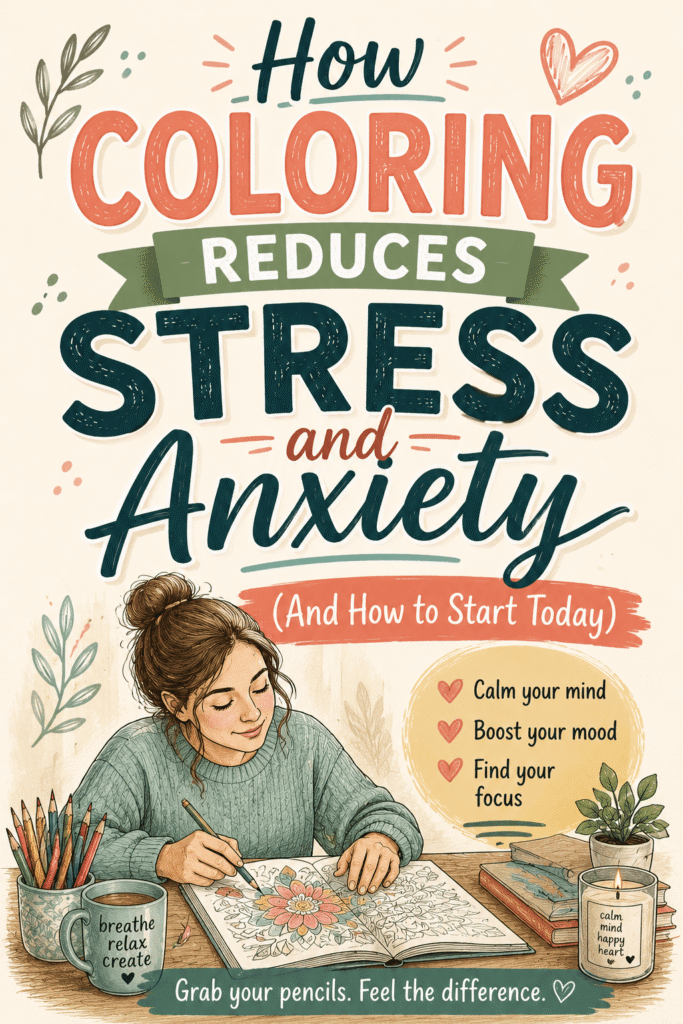
In this post, we will explore why coloring works so well for stress and anxiety, how to build a simple 10-minute routine around it, and where to find free calming coloring pages to get you started today.
Why Stress Feels So Heavy Sometimes
Stress is not just a feeling. It is a physical response. When something worries or overwhelms you, your body releases cortisol and adrenaline. Your heart rate rises. Your muscles tighten. Your mind starts racing through problems, possibilities, and worst-case scenarios.
This response is useful in a genuine emergency. But for most of us, the stress we carry day to day is not the kind that goes away on its own. It accumulates. And when it does, we can find ourselves feeling exhausted, irritable, or just vaguely unsettled without quite knowing why.
What the body needs in those moments is a signal that it is safe to rest. Something that says: you can slow down now. You can breathe.
That is exactly what calm, repetitive activities like coloring can offer.
How Coloring Helps Quiet a Busy Mind
You might wonder how something as simple as filling in a printed page with color could have any real effect on stress or anxiety. The answer has to do with how your brain processes focused, gentle activity.
When you color, your brain shifts its attention to something immediate and sensory. You are watching color meet paper. You are thinking about which shade to use next. That kind of soft focus naturally pulls your mind away from the loop of anxious thoughts that stress tends to create.
Research has found that activities like coloring can lower cortisol levels and reduce physiological markers of stress. A study published in the journal Art Therapy found that just 45 minutes of creative activity significantly reduced cortisol in participants, regardless of their artistic experience or ability.
The key is that coloring does not require much cognitive effort. It is not problem-solving. It is not planning. It is simply doing, gently, with your hands and eyes working together in a rhythm that the body finds naturally soothing.
Many people describe the experience of coloring as feeling similar to a warm bath or a long, slow exhale. The world gets a little quieter. Time feels less urgent. And for a few minutes, the weight of everything else lifts just enough to breathe.
Why Simple Designs Feel More Relaxing
Not all coloring pages are created equal, especially when it comes to stress relief.
You may have tried a coloring book before and found it more frustrating than calming. Tiny spaces, intricate lines, and patterns that seem to demand precision can trigger the very tension you were hoping to release. If coloring made you feel like you were failing at something, that is not a reflection of you. It is a reflection of the design.
Pages with bold, clear outlines and generous spaces to fill work with your nervous system rather than against it. There is no guessing where the line ends. There is no straining to stay inside a tiny boundary. Your hand moves smoothly and the image grows beautifully, stroke by stroke.
This is especially true for adults who are newer to coloring, for seniors who may be managing some hand tremor or reduced fine motor control, and for anyone coloring as a way to decompress rather than to create something technically perfect.
At Coloring Willow, every page is designed with this in mind. The outlines are thick. The spaces are open. The subjects, such as flowers, birds, cozy scenes, are chosen because they are genuinely lovely to look at when finished. Simple does not have to mean plain. It can mean peaceful.
The Connection Between Coloring and Mindfulness
You may have heard the word mindfulness and assumed it meant sitting cross-legged in silence, trying to think about nothing. For many people, that kind of stillness is actually quite difficult, especially when anxiety is running high.
Mindfulness, at its core, simply means being present in what you are doing. Noticing what is happening right now, in this moment, rather than being carried away by thoughts of the past or future. And it turns out that mindfulness coloring, that is, coloring done slowly and with gentle attention, is one of the most accessible ways to practice this.
When you color mindfully, you notice the texture of the paper under your hand. You notice how the color looks wet from the pencil and then dries slightly lighter. You notice the small sound of pencil on page. These small observations pull you, gently and without effort, into the present moment.
You do not have to think about being mindful. Coloring tends to take you there naturally.
This is why coloring for anxiety works even for people who say they cannot meditate. It gives the busy mind something gentle to focus on, and that focus becomes, quietly, a form of rest.
How to Create a 10-Minute Coloring Routine
You do not need a long stretch of time to feel the benefits of coloring. Even 10 minutes, done consistently, can begin to shift how your nervous system responds to the stress of the day.
Here is a gentle way to build a small coloring ritual into your day.
- Choose a time that already exists in your day. After your morning coffee, before dinner, or in the quiet stretch before bed; look for a window that already has a natural pause built into it. Attaching a new habit to an existing one makes it much easier to maintain.
- Keep your supplies somewhere visible. A small basket on the coffee table with a few pencils and a printed page is all you need. When your supplies are easy to reach, the barrier to starting drops almost to nothing.
- Set aside your phone. Even 10 minutes without the pull of a screen makes a noticeable difference. Coloring and scrolling work against each other. Give the coloring its own quiet space.
- Let the colors choose themselves. Do not overthink which color to use. Reach for what feels right in the moment. There are no wrong choices. The goal is not a perfect image; it is 10 minutes of gentle presence.
- Notice how you feel when you finish. You do not need to journal about it or measure anything. Just notice. Most people find that even a short session leaves them calmer, slower, a little more settled. That noticing, over time, becomes its own reward.
Start with just a few days a week if daily feels like too much. Ease into it. The point is not to add another obligation to your life. It is to carve out a small, reliable moment of calm. You can even try forming a coloring group.
Easy Supplies to Start With
One of the things people love most about coloring is how little it costs to begin. You do not need a special kit or an expensive set of supplies. Here is what works well for most beginners.
- Colored pencils. A basic set of 24 colored pencils is all you need to start. Brands like Prismacolor or Crayola both work beautifully on printed coloring pages. Colored pencils are easy to control, blend gently, and do not bleed through paper the way markers sometimes can.
- Gel pens. If your hands tire easily, gel pens require very little pressure. They glide across the page smoothly and produce beautiful, saturated color. They are a wonderful option for anyone managing arthritis or reduced grip strength.
- Standard printer paper or cardstock. Most printable coloring pages print beautifully on regular 8.5 x 11 paper. If you want a little more body under your pencil or pen, try 65-pound cardstock. It holds color especially well and feels satisfying to color on.
- Good lighting. This one is often overlooked. Coloring in dim light strains your eyes and can actually make the process feel harder than it needs to. A simple lamp positioned over your work makes a noticeable difference in both comfort and enjoyment.
That is truly all you need. A few pencils, a printed page, and a comfortable place to sit. Everything else is optional.
Beginner Mistakes to Avoid
Coloring is one of the most forgiving creative activities there is. But there are a few habits that can accidentally make it feel harder or less satisfying than it should be. Here are the ones worth knowing about early.
- Pressing too hard with your pencil. Many beginners press down firmly, thinking it will produce richer color. It often does; but it also makes blending almost impossible and can dent the paper. Try light, layered strokes instead. Build color gradually. You have more control and the result tends to look softer and more beautiful.
- Choosing pages that are too complex too soon. If a page feels overwhelming before you even begin, it is the wrong page for right now. Start with large, open spaces and simple subjects. There is no prize for choosing the most detailed design. Choose the one that makes you want to pick up a pencil.
- Judging the result too harshly. The goal of coloring for stress relief is not to produce a gallery-worthy piece of art. It is to spend a few minutes in a gentle, focused, calming activity. If your rose is two shades of pink that do not quite match, that is perfectly fine. The process is what matters, not the outcome.
- Trying to finish a page in one sitting. You do not have to complete an entire page each time you sit down. Color for 10 minutes, set it aside, and come back tomorrow. A page you return to over several days can become a small, quiet ritual in itself.
The only real mistake in relaxing coloring activities is making them feel like work. If something is not feeling calming, change it. The page, the color, the time of day; any of these can shift.
A Final Thought
Stress is real, and it is heavy, and it deserves to be taken seriously. We are not suggesting that coloring will solve everything. But we do believe, genuinely, that small, consistent moments of calm can change the texture of a day.
Ten minutes of coloring will not fix a hard situation. But it might give you a few minutes of quiet in the middle of one. And sometimes, that is exactly what you need to find your footing again.
You deserve a moment of calm today. We hope coloring can be part of how you find it.
4 thoughts on “How Coloring Reduces Stress and Anxiety (And How to Start Today)”