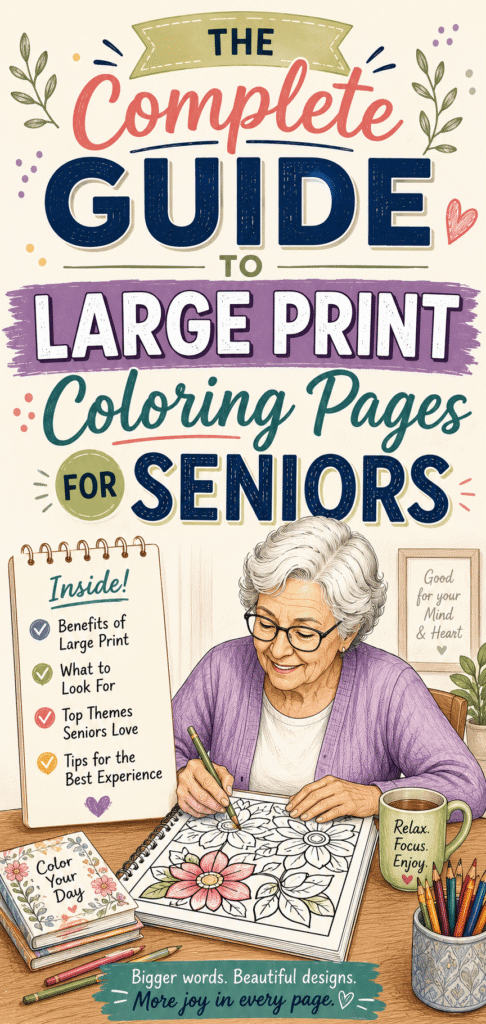

Large print coloring pages for seniors use bold outlines, generous open spaces, familiar subjects, and uncluttered layouts. They are designed for adults who want a comfortable, enjoyable creative activity, without the tiny sections and dense patterns that fill many traditional adult coloring books.
These pages can be a good fit for older adults who prefer clearer images, use broad-tip coloring tools, experience some changes in hand precision, or simply find intricate designs more tiring than satisfying. They work well for independent use, during family visits, or as part of an activity program in a senior center, assisted living community, or memory care setting.
The right coloring page should feel like an invitation, not a test. It gives someone a clear, approachable starting point for creative expression, quiet focus, or easy conversation.
What Are Large Print Coloring Pages?
Large print coloring pages are simplified coloring designs built around visual clarity and ease of use. The term “large print” is more commonly associated with enlarged text, but it has taken on a second meaning: coloring pages designed with features like these.
- Large, clearly defined shapes
- Bold black outlines
- Generous coloring areas
- Minimal interior detail
- Limited background elements
- Familiar, recognizable subjects
- Strong contrast between the artwork and the page
A typical large print coloring page might show one large flower, a bird perched on a simple branch, a teapot beside a cup, or a cottage with a few quiet landscape details. The main subject generally takes up most of the page, with enough white space around it that nothing feels crowded or confusing.
Large print coloring pages are not made only for people with vision changes. Many adults simply prefer open, uncomplicated illustrations over tightly packed patterns, and there is nothing wrong with that.
How Large Print Coloring Pages Differ From Traditional Adult Coloring Books
Many adult coloring books are built around intricate mandalas, dense floral arrangements, ornamental patterns, or detailed scenes packed with tiny sections. Working through them may require fine-tip pencils, careful hand control, and sustained visual concentration. Some people genuinely enjoy that kind of challenge. Others find it uncomfortable, frustrating, or simply not what they are in the mood for.
Large print coloring pages take a different approach.
| Traditional intricate coloring pages | Large print coloring pages |
| Numerous small spaces | Large open spaces |
| Thin or delicate lines | Bold, clearly visible outlines |
| Dense patterns | Simplified subjects |
| Multiple competing focal points | One dominant subject |
| Fine-tip tools often needed | Works with pencils, crayons, or markers |
| Longer completion time | Easier to finish in a shorter session |
| High demand for precision | More forgiving of imprecise movement |
One format is not better than the other. The right choice depends on the person’s interests, vision, hand comfort, concentration, and preferred level of challenge. A detailed page may be deeply satisfying for one older adult and genuinely exhausting for another. Offer a choice when you can, rather than deciding for someone.
Why Some Seniors Prefer Large Print Coloring Pages
The Subject Is Easier to Recognize
A clear central subject gives the person an immediate place to begin. One sunflower is usually easier to interpret than a page packed with dozens of overlapping flowers, leaves, insects, decorative borders, and abstract shapes. Recognition matters especially when someone experiences changes in visual processing or attention. Ideally, the subject should be clear without needing a written label to explain it.
The Outlines Are Easier to Follow
Bold black outlines create strong boundaries between coloring spaces. They help a person see the structure of the design and understand where to place each color. High contrast is a well-established accessibility principle, and the National Eye Institute’s guidance on low vision recommends adaptations such as increased contrast when appropriate.
A large print coloring page does not replace glasses, magnification, vision rehabilitation, or professional eye care. It is simply one practical way to make a visual activity more approachable.
Large Spaces Require Less Precision
Very small spaces can become difficult when someone experiences stiffness, fatigue, tremors, reduced grip strength, or limited hand coordination. Larger spaces give the hand more room to move and can accommodate broad-tip markers, crayons, and thicker pencils that may be easier to hold. None of this means a person needs to stay neatly inside every line. Coloring is a creative activity, not a motor-skill assessment.
The Page May Feel Less Overwhelming
A crowded page asks the eye to process many shapes, lines, and objects at once. A simpler page reduces the competing details. This may suit people who tire easily during visual activities, prefer shorter sessions, have difficulty deciding where to begin, or simply want a relaxing rather than demanding project.
Simple design can still look elegant and genuinely adult. Simplification removes unnecessary visual noise; it should not turn the artwork into something that belongs on a classroom worksheet.
Progress Is Easier to See
A person can realistically complete one large petal, a leaf, a cup, or a single section in a reasonably short time. Visible progress can make the activity feel manageable and satisfying. The page does not need to be finished in one sitting. It can be returned to later, or a person may decide that coloring one section was enough for the day — and that is completely fine.
What Coloring Can Offer Older Adults
Coloring is a recreational activity, not a treatment. It should not be described as a way to prevent dementia, restore memory, treat anxiety, or produce any guaranteed health outcome. That said, some research has explored how structured coloring may relate to short-term mood, anxiety, and focused attention.
For everyday use, the practical benefits are simpler and more immediate.
Creative expression. Coloring lets a person make choices without needing formal artistic skill. They can use realistic colors, try unusual combinations, blend shades, or leave areas uncolored. A blue rose is not a mistake. Personal choice is the whole point.
A structured quiet-time activity. Some people appreciate having a clear activity on hand during a quiet afternoon, before dinner, while music plays, or during a family visit. The printed page provides structure without requiring complicated preparation.
Flexible participation. Coloring can last five minutes or an hour. A person might color independently, chat while coloring, observe someone else working, or simply help select colors. Energy, interest, vision, and concentration are not always the same from day to day.
A natural way into conversation. Familiar subjects can spark conversation without any effort. A page showing a teapot might lead to a discussion about favorite drinks, kitchen routines, or family gatherings. A garden scene might invite stories about flowers, seasons, or a former home. There is no need to prompt anyone to remember a specific event. A simple observation is also a perfectly valid form of shared participation.
A shared activity. Two people can color separate copies of the same page or work on different areas together. In group settings, participants can use the same theme while choosing their own colors and pace. The goal is not identical finished pages — the value is in having an accessible activity everyone can approach in their own way.
What to Look for in Large Print Coloring Pages for Seniors
Not every product labeled “easy,” “bold,” or “large print” lives up to those descriptions. It is worth reviewing the actual page previews before downloading or purchasing.
One Clear Focal Subject
The main object or scene should be apparent within a few seconds. Good examples: one bird on a branch, a teacup and saucer, a watering can with two flowers, a loaf of bread on a cloth, or a bowl of fruit. Be cautious with pages that pack in many equally prominent objects. When a teapot, cake, flowers, window, cat, shelf, and patterned wallpaper all compete for attention, the page may no longer feel simple regardless of how it is labeled.
Bold, Consistent Outlines
Lines should print clearly on an ordinary home printer without fading, breaking, or varying unexpectedly in thickness. The outlines should be dark enough to separate clearly from the white background without consuming the coloring areas themselves.
Large Enclosed Spaces
Most coloring regions should be large enough to fill without constant fine adjustments. A few smaller details can add interest, but they should not dominate. Look carefully at flower centers, feathers, fur, baskets, and decorative borders; these areas often contain unexpectedly tiny sections.
Minimal Overlap
Heavy overlap can make it difficult to understand which line belongs to which object. A teapot beside a cup is easier to interpret than several dishes, utensils, flowers, and food items stacked across each other.
Strong Contrast
Black artwork on a clean white background provides the clearest contrast. Avoid pages with pale gray outlines, textured backgrounds, gray shading, photographic backgrounds, or watermarks across the image.
Familiar Subjects
Recognition supports an easy entry into the activity. Familiarity is personal, though — a farm tool immediately recognizable to one person may be completely unfamiliar to someone who spent their life in a city. Offer themes connected to the individual’s own interests and experiences when you can.
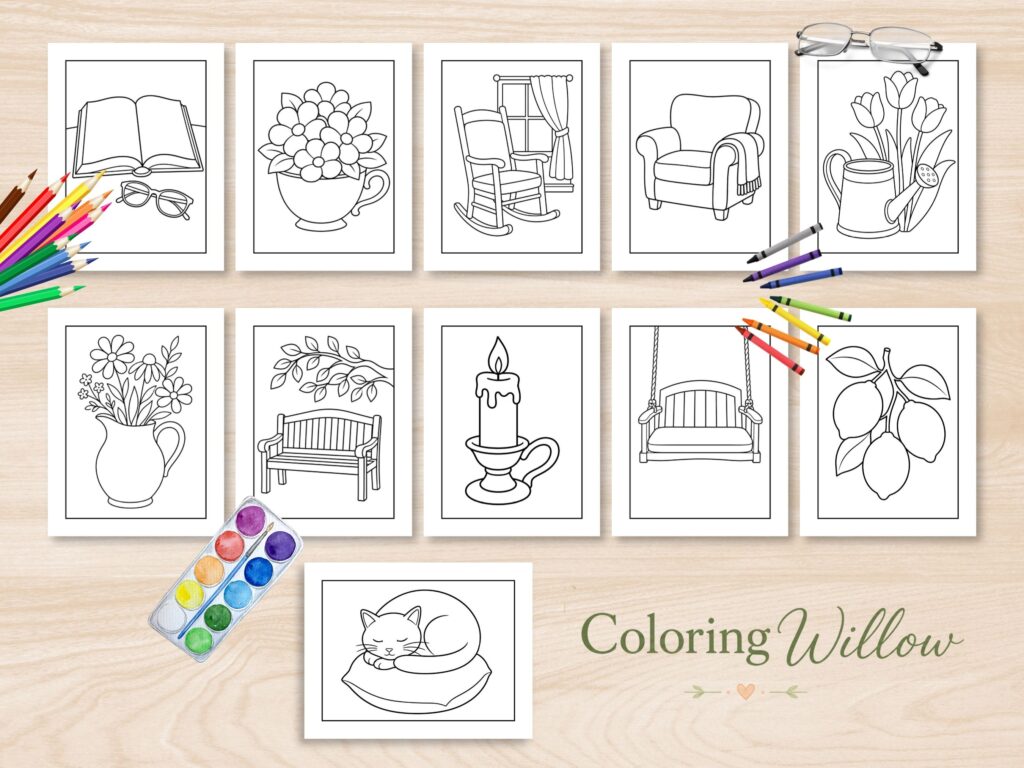
Adult-Appropriate Artwork
Large shapes and simple lines should not result in childish artwork. Avoid pages dominated by preschool-style characters, babyish expressions, reward stars, or juvenile slogans. Older adults deserve materials that reflect adulthood, individuality, and a lifetime of experience.
Generous Margins
The illustration should not run to the edge of the page. Adequate margins make home printing easier and give the person space to rest a hand or turn the page.
Honest Product Previews
When purchasing digital coloring pages, look for clear previews of the actual designs. A listing should tell you how many pages are included, the file format, the page size, whether it is a digital download, and what license is included.
Best Large Print Coloring Themes for Seniors
The best theme is the one the person genuinely likes. Age alone does not determine someone’s interests.
Flowers and gardens. Flowers simplify naturally into broad petals, leaves, stems, pots, and vases, and they offer many color choices without requiring realistic results. Sunflowers, tulips, roses, daisies, watering cans, and simple bouquets all work well. Avoid overly dense arrangements where dozens of petals pile on top of each other.
Birds and familiar animals. Robins, cardinals, owls, cats, dogs, rabbits, and sheep are familiar and versatile. The animal should look natural rather than like a character from a children’s cartoon. Fur, feathers, spots, and scales should be simplified rather than rendered as hundreds of tiny lines.
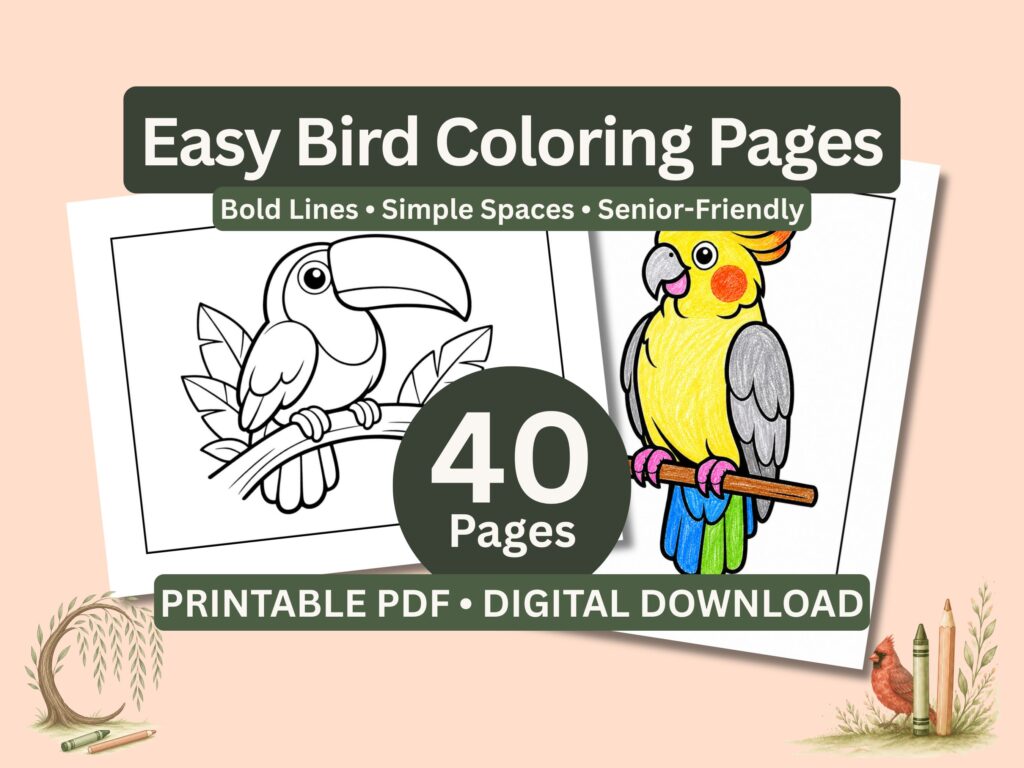
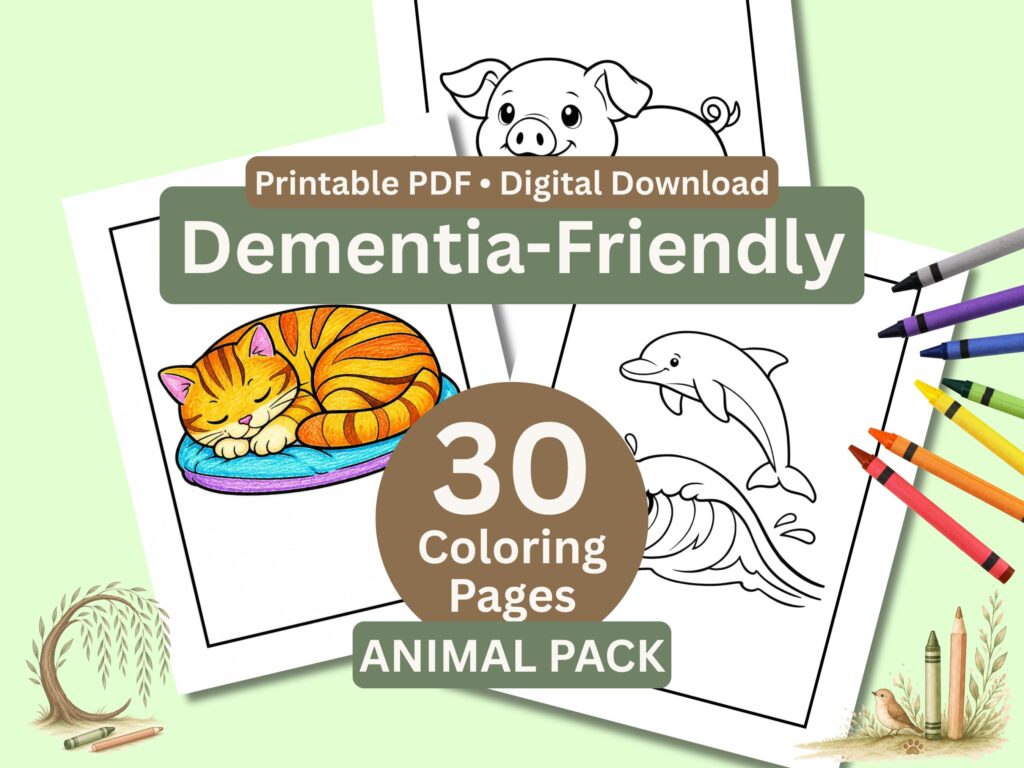
Cozy kitchen themes. A teapot and cup, a rolling pin beside some dough, a mixing bowl, a recipe box, a loaf of bread, or an apron on a hook — these subjects are easy to recognize and can naturally encourage conversation about meals, recipes, and daily routines.
Country and outdoor life. A barn, a farm gate, a bicycle with a basket, a cottage, a sailboat, or a porch chair can all work well. Keep backgrounds shallow and uncluttered. A single barn with one fence and a tree is almost always more accessible than a full farm scene filled with people, vehicles, buildings, and crops.
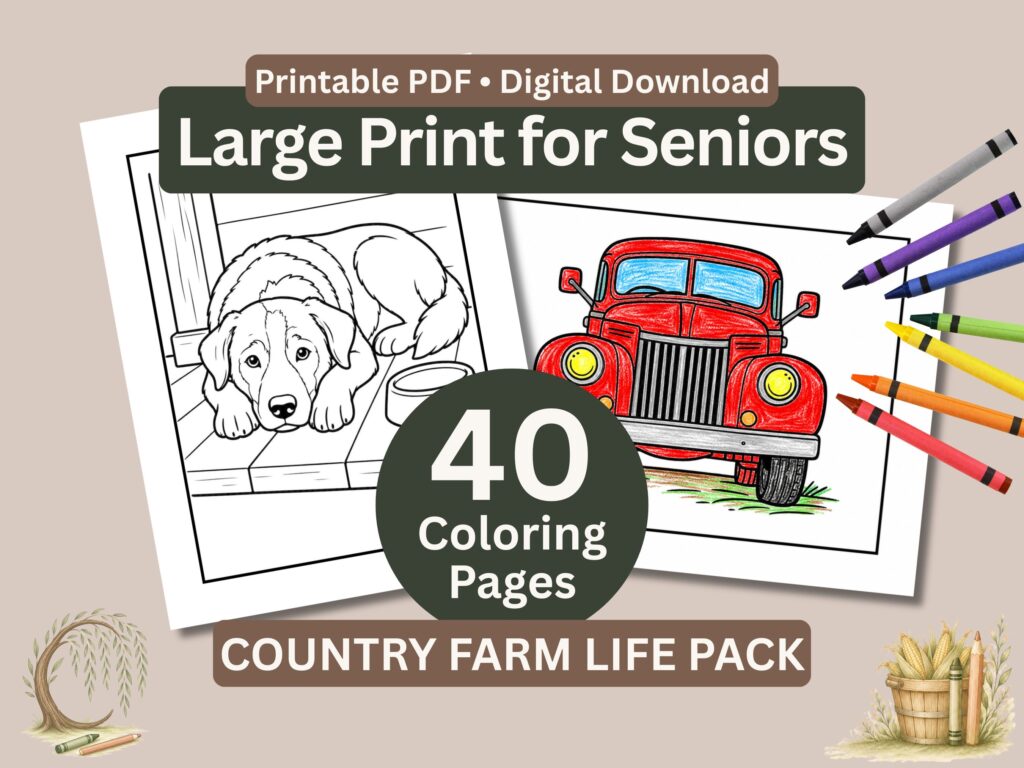
Hobbies and household objects. A knitting basket, a sewing machine, a fishing rod, a record player, a camera, or a set of gardening gloves can spark real conversation and genuine interest. When choosing hobby themes, think about the individual’s actual history rather than reaching for gender-based assumptions.
Seasonal subjects. Spring flowers, summer beach items, autumn leaves, winter mittens, pumpkins, harvest baskets, and snow-covered cottages all translate well into large, colorable formats. Religious or culturally specific subjects are best offered as an option rather than assumed to be meaningful to everyone.
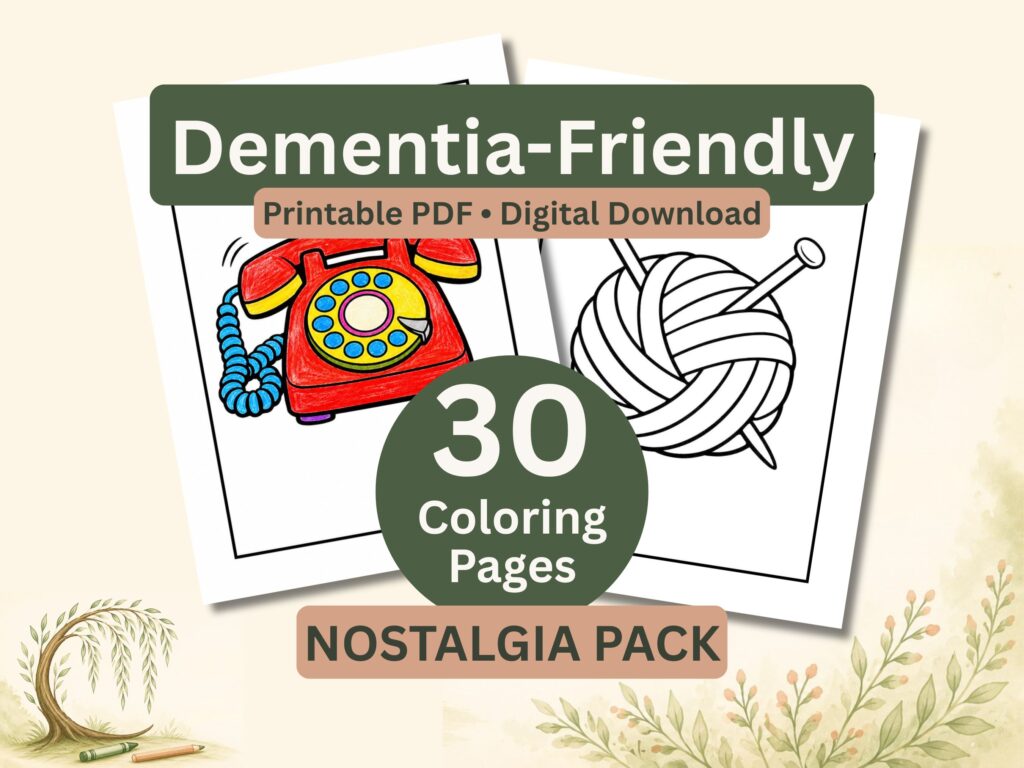
Nostalgic everyday objects. A rotary telephone, a typewriter, a vintage radio, a milk bottle, or a recipe card box can all make effective subjects when the design is historically coherent and the coloring spaces are generous. Nostalgia should not be assumed to feel positive for everyone.
Are Large Print Coloring Pages Suitable for People With Low Vision?
They may be suitable for some people with usable vision, but “large print” does not automatically make a page accessible to everyone with low vision.
Low vision varies widely. One person may benefit significantly from thicker lines and high contrast, while another may need magnification, specialized lighting, tactile materials, or a completely different activity. The National Eye Institute recommends speaking with an eye-care professional about vision rehabilitation when vision loss begins interfering with daily tasks.
When offering coloring to someone with low vision, ask directly whether the activity feels comfortable to see. Adjust lighting, reduce glare, place materials against a contrasting background, and provide broad-tip tools with strongly pigmented colors. Allow the person to bring the page closer or use magnification. If coloring is no longer comfortable, offer something else.
Never assume that someone wants to color just because the page has bold lines. Ask first, and respect the answer.
Large Print Coloring Pages for Adults Living With Dementia
Some large print pages may also be appropriate for adults living with dementia, but the two descriptions are not interchangeable.
A page is not dementia-friendly simply because it has a large subject. Dementia-friendly design also considers how well the subject is recognized, how much visual information the page presents at once, how complex the task feels, and whether the activity supports flexible participation without pressure.
What Makes a Coloring Page Genuinely Dementia-Friendly?
A thoughtfully designed page generally includes one unmistakable subject shown from a familiar angle, bold outlines, large enclosed spaces, minimal overlap, little or no background detail, and a simple optional instruction. The subject should not require visual problem-solving. A cup should look clearly like a cup, with a recognizable handle and opening. An animal should have natural proportions and an easy-to-read pose.
Choose Based on the Individual
The Alzheimer’s Association recommends considering the person’s interests, abilities, former routines, and preferences when planning activities, and adapting as needs change. Some people living with dementia may enjoy coloring for long stretches. Others may color only one area, choose colors for someone else to apply, watch, talk about the picture, or decline entirely. All of those responses deserve to be respected.
Use Non-Testing Language
Avoid phrases like “What color is this supposed to be?”, “Do you remember what this is?”, or “You went outside the line.” These can turn a relaxing activity into something that feels evaluative or uncomfortable.
Simple invitations work better: “Would you like to choose a color?” “We can color together.” “You may start anywhere you like.” “We can stop whenever you are ready.” “There is no right way to color it.”
Offer One Page at a Time
A stack of choices can feel overwhelming. Presenting one or two clearly different options makes selection easier: a flower and a bird, for example, rather than ten nearly identical floral pages.
Watch for Comfort, Not Completion
Signs that the activity is welcome might include looking closely at the page, selecting colors, making marks voluntarily, talking about the picture, or remaining comfortably engaged. Signs that a different approach may be needed include pushing materials away, appearing distressed, or losing interest. Stop, simplify, or change activities when any of those appear. A coloring page should never feel like an obligation.
Choosing Coloring Supplies for Seniors
The best tool is one the person can see, hold, and use comfortably. There is no single right answer.
Colored pencils offer good control and a wide range of colors. Softer pencils produce stronger color without much pressure. Standard pencils can feel too narrow for some people to grip, so triangular or thicker-barrel pencils are worth trying.
Markers create bright, visible color and require very little pressure. Broad-tip options cover large spaces quickly. They can bleed through thin paper, so placing a scrap sheet underneath helps. Caps may be difficult to remove for some people.
Crayons work well for large spaces and have a familiar feel. Thicker shapes can be easier to grip. Very pale colors may not provide enough contrast, so it is worth checking a set before offering it.
Gel pens produce vivid color but suit people who are comfortable with narrower tools and smaller movements. They tend to work better as an accent choice than a primary coloring tool.
Adaptive grips can increase the diameter of almost any pencil, crayon, or pen. An occupational therapist can provide individualized guidance when pain, weakness, or motor limitations significantly affect daily activities.
How to Prepare a Comfortable Coloring Area
The environment can matter just as much as the page itself.
Provide even light across the page. A movable task lamp can help, but brighter is not always better — glare and poorly positioned light can reduce visibility rather than improve it. Ask what feels comfortable.
Keep only what is needed on the table: one coloring page, a small selection of tools, and a scrap sheet if using markers. A large container with dozens of supplies can make choosing harder rather than easier.
A white page is easier to locate against a dark or medium-colored mat than against a white table. Colored tools are easier to find when they stand out from the container they are stored in.
Use a stable table and supportive chair. A clipboard, drawing board, or nonslip mat can help keep the paper steady. And follow the person’s preference when it comes to music or conversation — some people concentrate better in a quiet room, and some people do not.
How Caregivers and Family Members Can Use Coloring
During a family visit, coloring can ease the pressure of sustained conversation. Sitting side by side with something to do together leaves space for natural discussion without forcing it. Bringing two copies so the activity feels shared rather than supervised makes a genuine difference.
In a one-to-one setting, offer one page and a small set of tools. Start coloring your own page rather than hovering or repeatedly directing. Offer help only when it is clearly wanted or needed.
Activity staff in assisted living communities can prepare a range of themes and difficulty levels, let participants choose, keep extra copies available, and avoid ranking or comparing finished work.
In memory care settings, staff can offer one page at a time, demonstrate the first mark, provide a choice of two or three colors, color alongside the participant, and accept pointing, talking, or simply observing as full participation. Stopping when the person appears tired is always the right call.
For groups, simple preparation, accessible seating, good lighting, and clearly organized supplies go a long way. For a practical setup guide, see How to Start a Coloring Group at a Senior Center.
Printing Large Print Coloring Pages at Home
Choose “Actual size” or “100%” in the printer settings. Options like “Fit to page” may resize the design slightly, which can affect margins and line weight. Standard white paper works well for colored pencils and most crayons. For markers or heavier coloring, slightly thicker paper helps prevent bleed-through. Print one-sided to keep pages clean and easy to distribute.
Standard print quality is usually sufficient, though high-quality black printing may improve line clarity on some printers. Before printing a full collection, test one representative page and check how the outlines look, whether the margins are comfortable, and how the page performs with the intended tools.
For storage, labeled folders, a binder with page protectors, an accordion file, or a tabletop basket all work well. Avoid presenting too many choices at once, even when plenty of pages are available.
Common Mistakes to Avoid
Assuming every senior wants easy pages. Some older adults enjoy highly detailed art and may find simplified pages uninteresting. Offering a range is almost always better than deciding for someone.
Calling every bold page dementia-friendly. Dementia-friendly design involves more than thick outlines. It also considers recognition, cognitive load, emotional tone, task structure, and individual variation.
Treating coloring as therapy. Coloring may be enjoyable, calming, absorbing, or social. It is not a substitute for medical treatment, occupational therapy, mental health care, or individualized dementia support.
Correcting color choices. Leaves do not need to be green and skies do not need to be blue. Personal color choices are part of the activity.
Emphasizing staying inside the lines. The purpose is participation, not precision. Comments about mistakes can quietly turn a relaxing activity into a performance.
Overwhelming a person with supplies. A limited, well-chosen selection often works better than a hundred options.
Continuing after interest has gone. A short, positive experience is always worth more than a completed page.
Frequently Asked Questions
Are large print coloring pages only for seniors? No. They may also suit beginners, adults with low vision, people who prefer broad-tip tools, adults with limited hand precision, and anyone who dislikes tiny or intricate coloring spaces.
How large should the coloring spaces be? There is no single measurement. Most major areas should be large enough to fill comfortably with the intended tool. A few smaller details can add interest, but they should not dominate.
Are large print pages suitable for arthritis? They may be more comfortable because broad spaces can reduce the need for very precise movement. Tool choice, grip, posture, and session length also play a role. An occupational therapist can provide individualized guidance when arthritis significantly affects hand function.
Can someone with dementia use large print coloring pages? Some people living with dementia enjoy coloring, particularly when pages use familiar subjects, clear outlines, and simplified layouts. Suitability depends on the person’s preferences, vision, comfort, and current stage of need.
What are the best coloring tools for large spaces? Broad-tip markers, crayons, and soft colored pencils can all work well. The best tool is the one the person can hold comfortably and see clearly.
Should pages be printed single-sided? Yes, especially with markers. Single-sided pages are also easier to distribute, display, and reprint individually.
What paper should I use? Standard printer paper works well for pencils and crayons. Slightly heavier paper helps when working with markers.
Is coloring appropriate for a senior center group? Yes, when participants are interested and the environment is accessible. Offer varied difficulty levels, comfortable seating, good lighting, organized supplies, and genuine freedom to participate without comparison.
Does coloring improve memory? Coloring should not be presented as a treatment for memory loss or a reliable way to improve memory. It is better described honestly: an enjoyable creative activity that may support engagement, conversation, and quiet focus for some people.
How long should a coloring session last? There is no required duration. Let comfort, interest, and energy determine the length. A few minutes can be just as worthwhile as an hour.
Choosing the Right Page
A good large print coloring page brings clarity and adult dignity together. Look for a familiar, recognizable subject, bold black outlines, large open spaces, minimal background detail, strong contrast, comfortable margins, adult-appropriate styling, and a level of detail that genuinely suits the individual. And whenever possible — let the person choose.
Large print coloring pages are easy to prepare, flexible to use, and adaptable to a wide range of preferences and settings. The finished picture is not the only measure of a good session. Choosing a color, filling one section, sharing a story, or spending a quiet moment side by side can be more than enough.