
This article provides general educational information and is not a substitute for medical advice, diagnosis, or treatment. Consult an appropriately qualified healthcare professional about individual concerns.
Coloring can be a genuinely enjoyable activity for some adults living with dementia when the page, supplies, setting, and level of support match the person’s interests and current abilities. Suitable pages usually have familiar subjects, bold outlines, large open spaces, and minimal background detail. The activity should be offered as a choice, not presented as a memory exercise or a task that must be completed.
Participation can look many different ways. A person might color an entire page, fill in one section, choose the colors for someone else to apply, talk about the picture, or simply sit with the group. Each of these is a valid form of participation.
This guide explains how caregivers and activity professionals can choose appropriate pages, introduce coloring respectfully, adapt the activity, and recognize when it is time to continue, simplify, or stop.
Key point: Coloring is a recreational activity, not a treatment for dementia. It should not be expected to improve memory, slow cognitive decline, or produce a particular emotional or behavioral result.
Can Adults Living With Dementia Enjoy Coloring?
Yes. Many adults living with dementia enjoy coloring, especially when the subject is familiar and the activity does not place pressure on memory, language, or fine motor precision.
The Alzheimer’s Association recommends choosing activities based on the person’s interests, former routines, abilities, and current needs. Activities that people have long enjoyed can often be adapted as their needs change. Its activity-planning guidance for dementia caregivers emphasizes enjoyment, safety, and individual preferences over any particular format.
Coloring can be appealing because it has a clear starting point. The person does not need to recall instructions from an earlier page, produce a correct answer, or complete a sequence of steps. The activity can also flex to fit the day. Someone may color independently on one occasion and prefer company or minimal involvement on another. A person who does not want to hold a pencil may still enjoy choosing colors or talking about the picture.
That said, coloring is not the right fit for everyone. Some adults have never found arts or crafts interesting. Others may find coloring childish, visually tiring, physically uncomfortable, or simply not appealing. A person’s response matters more than any caregiver’s intention. Offer the activity, observe without judging, and respect a refusal without pushing.
The National Institute on Aging recommends adjusting activities to a person’s abilities and interests rather than expecting the same approach to work every time. Its guide to adapting activities for people with Alzheimer’s disease also encourages caregivers to stay flexible as needs shift over time.
What Makes a Coloring Page Dementia-Friendly?
A dementia-friendly coloring page is intentionally designed to reduce unnecessary visual, cognitive, and motor demands. It is not simply a standard adult coloring page with a larger title. It should make the subject easy to recognize and the activity easy to begin.
Look for these features:
- One clear focal subject
- Familiar, concrete imagery
- Bold and consistent black outlines
- Large enclosed coloring spaces
- Strong contrast between the lines and the white background
- Minimal overlap between objects
- Little or no background detail
- A stable, familiar viewing angle
- Generous white space
- Adult-appropriate artwork
- No hidden objects or visual puzzles
- No complicated written instructions
A page showing one large teapot with a cup is usually far easier to approach than a crowded kitchen containing shelves, dishes, food, appliances, windows, curtains, and decorative patterns. The main image should be recognizable within a few seconds. A flower should have a clear shape. A cup should have an identifiable handle and opening. A bird should look like a bird, with natural proportions and a simple pose.
Open coloring spaces matter too. Pages filled with tiny petals, fine feather lines, lace patterns, brickwork, or repeated ornamental motifs can require sustained visual attention and precise hand movements. A dementia-friendly page uses broad shapes and limited internal detail. The person should not have to solve the image before coloring it.
Design should remain adult-appropriate. Simple does not mean juvenile. Avoid nursery-style lettering, exaggerated cartoon expressions, reward stars, childish characters, and language that addresses the person as though they were a child.
For a broader comparison of bold and accessible designs, see The Complete Guide to Large Print Coloring Pages for Seniors.
Dementia-Friendly Note: Large print and dementia-friendly design are not the same thing. Large print may improve visibility, while dementia-friendly design also considers recognition, attention, the structure of instructions, emotional safety, and flexible participation.
How Dementia May Affect Participation in Coloring
Dementia can affect memory, attention, communication, judgment, visual processing, movement, and the ability to organize steps. The pattern and degree of change vary considerably from person to person.
A diagnosis alone does not tell you how someone will respond to coloring.
One person may recognize objects easily but have difficulty choosing between many colors. Another may understand the activity but tire after a few minutes. Someone else may enjoy detailed designs because coloring has been a lifelong pleasure. Possible challenges include:
- Difficulty deciding where to begin
- Trouble distinguishing the main subject from the background
- Reduced attention over longer periods
- Difficulty retaining multi-step instructions
- Problems choosing among many supplies
- Reduced hand strength or coordination
- Difficulty seeing faint lines
- Sensitivity to noise, clutter, or interruptions
- Fatigue or variable energy across the day
Visual processing can also affect participation. The eyes may receive information clearly while the brain has difficulty organizing what is being seen. This is one reason simple subjects, strong contrast, limited overlap, and uncluttered backgrounds can help some participants approach the page more easily.
Avoid assuming that every difficulty is caused by dementia. Pain, poor lighting, medication effects, low vision, hearing changes, fatigue, anxiety, an uncomfortable chair, or an unfamiliar environment may also play a role. Observe what is happening in the moment and adapt the activity accordingly.
How to Tell Whether Coloring Is a Good Fit
Start with the person’s interests rather than the diagnosis.
Consider whether they have enjoyed activities like drawing, painting, sewing, needlework, gardening, decorating, crafts, or looking at illustrated books. Past interest can provide a useful starting point, but it is not required. Someone who never colored before may still enjoy trying it. Someone who once loved art may no longer want to participate.
Offer the activity without making it feel like an assessment.
You might say:
- “Would you like to try this flower page?”
- “I brought a few colors. Would you like to choose one?”
- “We can color together for a while.”
- “Would you prefer the bird or the teapot?”
Then watch the response.
Coloring may be a reasonable fit when the person looks at the page with interest, reaches for a tool, chooses a color, begins making marks, talks about the image, or simply appears comfortable watching someone else color.
It may not be the right activity when the person repeatedly turns away, pushes the materials aside, appears confused or distressed, or says they do not want to participate. A refusal does not need to be overcome. Try another activity or leave the option open for another time.
The Best Coloring Page Subjects for Adults With Dementia
The most suitable subject is one the person can recognize and is comfortable seeing.
Familiar subjects usually require less interpretation than abstract patterns. They may also create natural opportunities for conversation without demanding exact recall.
Useful themes can include:
- Flowers and garden objects
- Birds and familiar animals
- Teacups, teapots, and kitchen items
- Fruit and familiar foods
- Household objects
- Hobbies and tools
- Rural or neighborhood scenes
- Seasonal items
- Familiar transportation
- Everyday objects from earlier decades
A large sunflower, a watering can, a loaf of bread, a sewing basket, or a bicycle can all work well when presented clearly and without a crowded background.

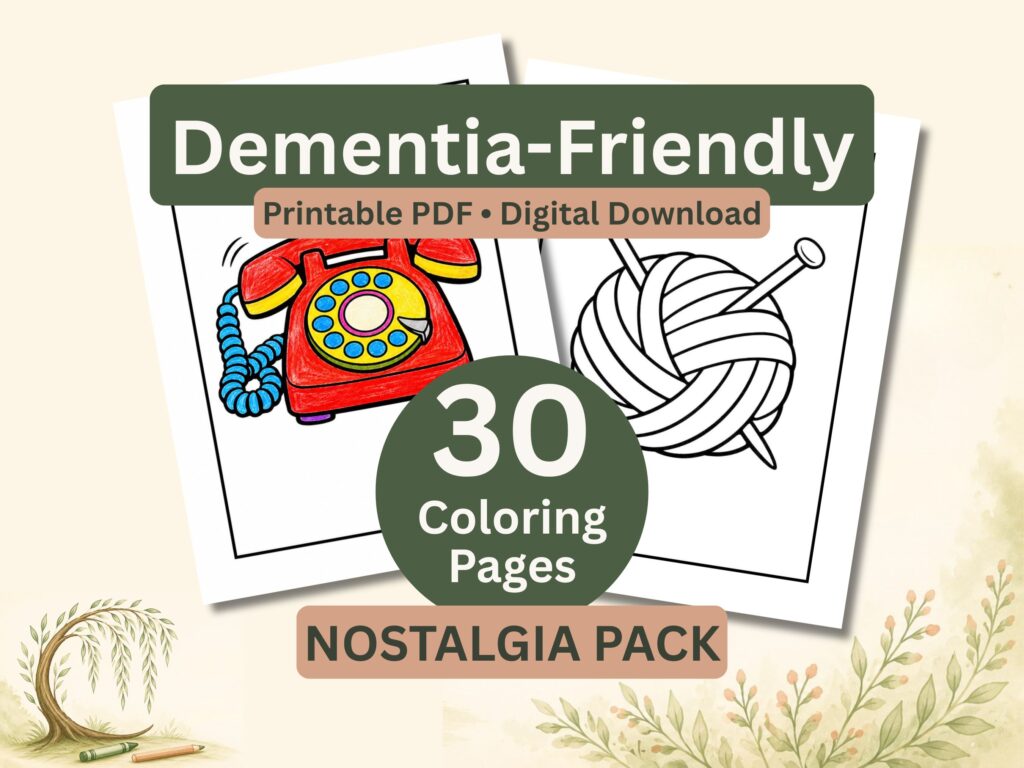
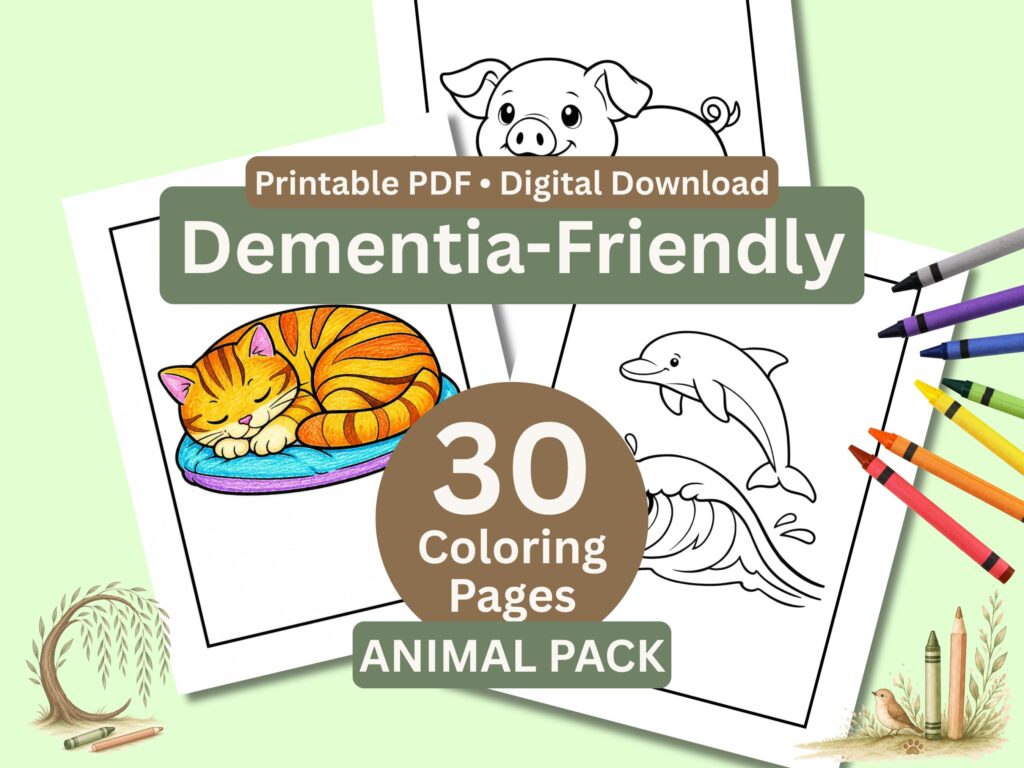
Familiarity is personal and cultural. A farmhouse scene may be deeply meaningful to one person and irrelevant to another. A vintage radio may feel immediately familiar to some adults but not to people from a different generation, region, or life experience. Do not assume that every older adult enjoys nostalgia, or that past experiences are universally positive.
Use particular care with subjects involving weddings, children, religious services, military life, hospitals, immigration, family gatherings, holidays, employment, or bereavement. These themes can prompt meaningful conversation, but they may also carry grief, conflict, fear, or difficult memories.
When you know the person’s background, choose themes that reflect their actual interests rather than relying on gender or age stereotypes. Do not automatically offer flower and sewing pages to women or tools and fishing pages to men. Ask, observe, and provide variety.
How to Choose the Right Difficulty Level
Difficulty should be based on what the person can comfortably approach today, not on a fixed label.
A useful approach is to prepare a few levels of visual complexity.
Supported recognition pages have one large subject, very few sections, and little or no background. The person may choose between one or two colors, point, watch, or make a few marks.
Simple participation pages have several broad coloring areas and one short instruction. They may include one small supporting object, such as a cup beside a teapot.
Moderately detailed pages include more sections and may suit someone who enjoys longer periods of independent coloring. The design should still have a clear focal point and readable outlines.
Start with a page that appears manageable, but do not automatically choose the simplest design available. An overly basic page may feel patronizing or uninteresting to someone who prefers more complexity.
Offer two clearly different choices rather than a large stack. Showing one flower page and one bird page is usually enough. The same person may prefer different levels on different days, since fatigue, sleep, pain, medication timing, and mood can all affect participation. Treat difficulty as adjustable rather than fixed.
You can also simplify the experience without replacing the page by offering fewer colors, starting one section together, covering part of a busy page, switching to a broader coloring tool, improving the lighting, or simply shortening the session.
Coloring Supplies That May Be Easier to Use
The best coloring tool is the one the person can see, hold, and move comfortably. There is no single supply that works for everyone.
Soft colored pencils can provide good control and a wide range of colors. Softer pencils usually produce stronger color with less pressure than hard pencils. Thin pencils may be uncomfortable for someone with joint pain or reduced grip strength. Thick-barrel or triangular pencils may feel more stable.
Broad-tip washable markers cover large areas quickly and usually require less pressure. Their strong color may also be easier to see. They can bleed through ordinary paper, so placing a scrap sheet beneath the page helps. Caps can be difficult to remove, so opening them in advance can make things easier for the participant.
Crayons are familiar and work well on broad areas. Larger or twist-up crayons may be easier to hold than standard pencils. Choose adult-appropriate supplies and presentation. A quality container of crayons can feel quite different from a child-themed box covered in cartoon characters.
Gel pens create vivid color but usually require a narrower grip and more controlled movement. They tend to work better for participants who still enjoy moderate detail and finer work.
Adaptive grips can increase the diameter of a pencil, crayon, or pen, and may reduce the amount of finger flexion required. Do not assume a larger grip will automatically help, though. Some grips change the tool’s balance or simply feel uncomfortable.
An occupational therapist can assess hand function and recommend individualized adaptations when pain, stiffness, weakness, tremor, or coordination difficulties affect daily activities.
How Vision Changes Can Affect Coloring
Dementia and low vision are separate concerns, though a person may experience both.
Low vision can make it harder to read, recognize faces, distinguish colors, or complete everyday visual tasks. The National Eye Institute’s overview of low vision explains that low vision is not fully corrected through ordinary glasses, contact lenses, medication, or surgery. A bold coloring page may help some people, but it is not a substitute for an eye examination or vision rehabilitation.
Practical adjustments to consider:
- Use black outlines on white paper and avoid pale gray linework
- Provide even task lighting without glare from windows or glossy surfaces
- Place the page on a contrasting mat
- Use strongly pigmented colors
- Offer broad-tip tools
- Allow the person to move the page closer
- Use magnification when recommended
- Check that shadows do not fall across the page
Ask whether the page is comfortable to see rather than relying only on whether the person begins coloring. The National Eye Institute also provides information about vision rehabilitation services, which can help people adapt everyday activities to changes in vision. Seek professional guidance when a person shows new visual difficulties, frequently misses objects, appears unable to distinguish boundaries, or reports visual discomfort.
How to Set Up a Comfortable Coloring Environment
A well-designed page can still be difficult to use in an uncomfortable environment.
Set up the activity before inviting the person to begin. This reduces waiting and unnecessary decisions at the start.
Use a stable table with enough space for the person’s arms and materials. Choose a supportive chair where both feet can rest comfortably. Position the page within easy reach, and use a clipboard, drawing board, or nonslip mat to prevent it from sliding.
Keep the table simple. A practical setup might include one coloring page, five or six clearly different colors, one preferred type of tool, a scrap sheet under the page, and an optional sharpener or magnifier. A container filled with dozens of pencils may look appealing but can make selection harder.
Lighting should be even and comfortable. Avoid placing the person directly in front of a bright window or under a lamp that causes glare.
Background sound should match the person’s preference. Some people work more comfortably with familiar music or gentle conversation. Others prefer quiet surroundings.
Choose a time that fits the person’s usual routine and energy. A person who is tired, hungry, uncomfortable, or waiting for another activity may have little interest in coloring even when the page itself is well suited to them.
Practical tip: Prepare the table first, then offer the activity. Avoid asking the person to wait while you find pages, sharpen pencils, or clear the workspace.
How to Introduce Coloring Without Pressure
The way you introduce the activity can shape how it feels.
Avoid presenting coloring as something the person should do for their memory, behavior, or health. This can make an optional activity feel like treatment or testing. A simple, relaxed invitation works far better.
A useful sequence:
- Choose a calm moment.
- Offer one or two page options.
- Present a small selection of supplies.
- Use one short sentence.
- Allow time for a response.
- Demonstrate only when it helps.
- Join the activity rather than supervising it.
- Stop when the person loses interest.
Useful phrases include:
- “Would you like the flower or the bird?”
- “You can choose any color.”
- “We can do this together.”
- “You may start anywhere.”
- “There is no need to finish.”
- “We can try something else.”
Phrases to avoid:
- “This will improve your memory.”
- “You should know what to do.”
- “That is the wrong color.”
- “Try to stay inside the lines.”
- “Keep going until you finish.”
- “This should be easy.”
- “Do you remember what this is?”
Give the person time to look at the page before asking anything. Repeating instructions quickly can add pressure rather than provide help. When demonstration is useful, make one or two marks on your own page. Avoid taking the person’s hand or directing their movement unless that kind of assistance is clearly welcomed.
How Caregivers Can Provide the Right Amount of Support
Good support makes participation easier without taking control away from the person.
Begin with the least assistance needed. You might prepare the supplies, place the page in a comfortable position, and simply wait. If the person does not begin, offer a specific color or point calmly to a large section. If more support is helpful, color beside the person and allow imitation to occur naturally.
Give one instruction at a time:
- “Choose a color.”
- “You can start with this petal.”
- “Would you like another pencil?”
- “We can stop now.”
Avoid giving several directions at once.
If the person asks repeatedly what to do, respond calmly. Point to the page or demonstrate rather than giving a longer explanation. When someone colors outside the lines, no correction is needed. The page is not an assessment of motor control.
When someone chooses an unexpected color, respect the decision. A purple tree or a blue sunflower can be part of creative expression.
When the person pauses, wait. Do not assume they need encouragement to continue. You can gently ask whether they would like another color, a break, or to stop altogether. Support can also mean accepting different forms of participation. The person may point, speak, hum, sort pencils, or simply talk about what they see in the image.
The World Health Organization’s iSupport program for dementia caregivers provides broader skills and guidance for family members and other informal caregivers.
Coloring Together as a Shared Activity
Coloring together often feels more natural than placing a page in front of someone and watching them work.
Sit beside the person rather than across the table when you can. Side-by-side participation reduces the sense of being observed or assessed. Use two copies of the same page or two pages from the same theme. Work on your own page and let conversation arise without forcing it.
Shared coloring can support comfortable pauses, natural conversation, joint attention, familiar routines, quiet companionship, and moments of genuine connection without any agenda attached to them.
Avoid turning the activity into a lesson. You do not need to demonstrate the correct way to color.
Ask simple questions only when they fit naturally:
- “Which color do you like?”
- “Have you seen flowers like these?”
- “Would you like the green pencil?”
- “What do you notice in the picture?”
Do not pressure the person to recall names, dates, or events. A conversation about what is on the page right now is completely enough. When a story does emerge, listen without correcting personal memories. The goal is shared time, not historical accuracy.
Signs the Activity Is Comfortable and Engaging
Engagement does not always look like sustained independent coloring.
A person may participate quietly or mostly nonverbally. Observe the whole interaction rather than judging the finished page.
Possible signs of interest and comfort include:
- Looking closely at the image
- Reaching for a tool
- Choosing between colors
- Making marks voluntarily
- Maintaining a relaxed posture
- Talking about the subject
- Smiling naturally
- Humming or speaking while coloring
- Returning to the page later
- Watching another person color with interest
- Showing the page to someone else
These are encouraging signs, but they should not be interpreted as clinical outcomes or measures of cognitive function.
Success does not require the person to finish the page, stay inside the lines, use realistic colors, work independently, speak, remain seated for a set time, or produce a recognizable result. Coloring one section may be enough. Choosing the colors may be enough. Sitting comfortably with the group may be enough.
Signs It May Be Time to Pause, Adapt, or Stop
Stop or adjust the activity when the person appears uncomfortable.
Possible signs include pushing materials away, repeatedly turning from the table, showing visible frustration, asking the same procedural question over and over, struggling to see the page, reporting pain, tightening the grip excessively, appearing restless or distressed, or simply losing interest.
When any of these appear, try one simple adjustment at a time. You might offer a less detailed page, reduce the number of colors, switch to a broader tool, improve the lighting, move the page closer, secure the paper, or sit alongside the person. If the person clearly wants to stop, stop.
Stopping is not failure. A five-minute activity can be complete in itself.
A difficult session also does not mean coloring will never be suitable again. Interest and comfort may be quite different at another time, with another subject, in another setting, or simply on another day.
Common Mistakes Caregivers Should Avoid
Treating coloring as a memory test. Do not ask the person to prove that they recognize the object or remember the correct colors.
Choosing pages based only on age. Interests, life experience, vision, dexterity, and personal preference matter far more than chronological age.
Assuming every simple page is dementia-friendly. A page may have bold lines but still contain ambiguous shapes, excessive overlap, or a childish visual style.
Offering too many choices. A large stack of pages or a container with dozens of colors can make it genuinely difficult to begin.
Correcting the result. Avoid commenting on colors, missed sections, uneven strokes, or marks outside the lines.
Using exaggerated praise. Repeated statements like “Good job!” can sound patronizing when delivered in a child-directed tone. Specific, natural observations work better: “You chose a strong blue,” or “I like how those colors look together.”
Insisting on completion. The finished page is not the only useful outcome.
Ignoring physical comfort. Hand pain, poor posture, glare, fatigue, and tool size can determine whether the activity works or does not, regardless of how appropriate the page itself is.
Using childish materials. Cartoon packaging, preschool images, and reward-style language can undermine adult dignity in ways that are easy to overlook.
Continuing after interest has ended. Respect the person’s decision to stop.
Making medical claims. Coloring does not prevent dementia, restore memory, slow disease progression, or replace professional care.
Using Coloring in Memory Care and Group Settings
Coloring can be offered in memory care communities, adult day programs, assisted living settings, and small activity groups when the format stays flexible and participation is genuinely optional.
Prepare the room before participants arrive. Arrange seating, lighting, pages, and supplies so the session can begin without a lengthy introduction.
Provide several clearly different themes and levels of detail. Avoid distributing the same page to everyone unless participants actively prefer that.
Group instructions can be brief: “Choose a page and any colors you like. You may color as much or as little as you prefer.”
Allow participants to work independently, receive one-to-one help, color alongside staff, watch the group, talk, leave early, return later, or decline entirely. Avoid ranking or displaying finished pages competitively. Ask permission before posting artwork or sending photographs to family members.
Watch for different support needs within the group. One participant may need a page secured to the table. Another may prefer more detailed artwork. Someone else may need fewer color choices or better lighting. Mixed-ability groups work best when staff prepare alternatives rather than expecting one page to suit everyone.
For group planning guidance, see How to Start a Coloring Group at a Senior Center.
Check the product license before making copies for a group, facility, or activity program. A personal-use license may not permit organizational distribution.
How to Print Dementia-Friendly Coloring Pages at Home
Print coloring pages at their intended size whenever possible. Choose “Actual Size” or “100%” in the printer settings, and review the print preview to confirm no part of the image is cropped.
Use clean white paper for strong contrast. Standard printer paper is usually suitable for pencils and crayons. Use slightly heavier, printer-compatible paper for markers, and place a scrap sheet beneath the page to protect the table and absorb any bleed-through.
Print pages one-sided. This prevents marker ink from affecting the image on the reverse and makes pages easier to distribute, place on a clipboard, or replace.
Avoid draft mode when it produces faint lines. Bold outlines should remain clearly visible after printing.
Before producing a large set, print one sample and check the line darkness, subject size, margins, and how the page performs with the intended coloring tools. Store pages by theme or difficulty level, but present only a small selection at a time.
Frequently Asked Questions
Is coloring good for adults with dementia?
Coloring can be an enjoyable activity for some adults living with dementia. It may offer opportunities for creative expression, shared time, and comfortable participation. It is not a treatment, and it should not be expected to improve memory or slow dementia progression. Suitability depends on the person’s interests, vision, dexterity, energy, and current abilities.
Can coloring improve memory?
There is not enough evidence to describe ordinary coloring as a method for improving memory in people living with dementia. Presenting it as brain training or treatment is not accurate. Coloring is better understood as an optional creative activity that may support engagement, conversation, and personal choice.
What kind of coloring pages are best for dementia?
Pages with one recognizable subject, bold outlines, large enclosed spaces, strong contrast, minimal overlap, and little background detail are often easier to approach. The subject should be adult-appropriate and familiar to the individual. Avoid crowded scenes, hidden objects, intricate patterns, and visually ambiguous artwork.
Are standard adult coloring books too difficult?
Some are. Many adult coloring books contain mandalas, tiny patterns, thin lines, and highly detailed scenes. These may be frustrating for someone who experiences changes in visual processing, attention, or precise hand movement. Other adults living with dementia may still enjoy detailed pages. The person’s response is the most reliable guide.
How many colors should I offer?
Start with approximately four to six clearly different colors. Reduce the number when choosing appears difficult, and offer more when the person wants greater variety. Avoid many nearly identical shades unless the person enjoys comparing subtle differences.
What supplies are easiest to hold?
Thick-barrel pencils, broad-tip markers, larger crayons, twist-up crayons, and tools fitted with adaptive grips may help. Comfort varies between individuals. Consider grip, hand strength, vision, preferred pressure, and the size of the coloring spaces when making a choice.
How long should a coloring session last?
There is no required duration. A session may last several minutes or considerably longer. Continue while the person appears comfortable and interested. Pause or stop when fatigue, pain, frustration, restlessness, or loss of interest appears.
What should I do if the person colors outside the lines?
Do not correct the marks. Staying inside the lines is not the purpose of the activity. Allow the person to color freely unless they ask for help. Comments about errors can quietly turn a recreational activity into a performance test.
Can coloring be used in memory care groups?
Yes, when participation is optional and materials are adapted to individual needs. Provide varied page difficulty, adequate lighting, adult-appropriate supplies, simple instructions, and enough support. Avoid competition, forced completion, or public correction.
What if the person does not want to color?
Respect the decision. Offer another activity, conversation, music, a familiar object, or quiet companionship. You may offer coloring again on another day, but there is no need to persuade.
Are large print and dementia-friendly coloring pages the same?
No. Large print generally means larger, clearer visual elements. Dementia-friendly design also considers recognition, cognitive load, familiarity, instruction structure, emotional safety, and flexible participation. A large page may still be visually confusing or too complex for a particular person.
Should caregivers help complete the page?
Help only when the person welcomes it. You might secure the paper, open marker caps, offer a specific color, demonstrate on your own page, or simply color alongside the person. Avoid taking over in order to produce a finished picture.
A Practical Caregiver Checklist
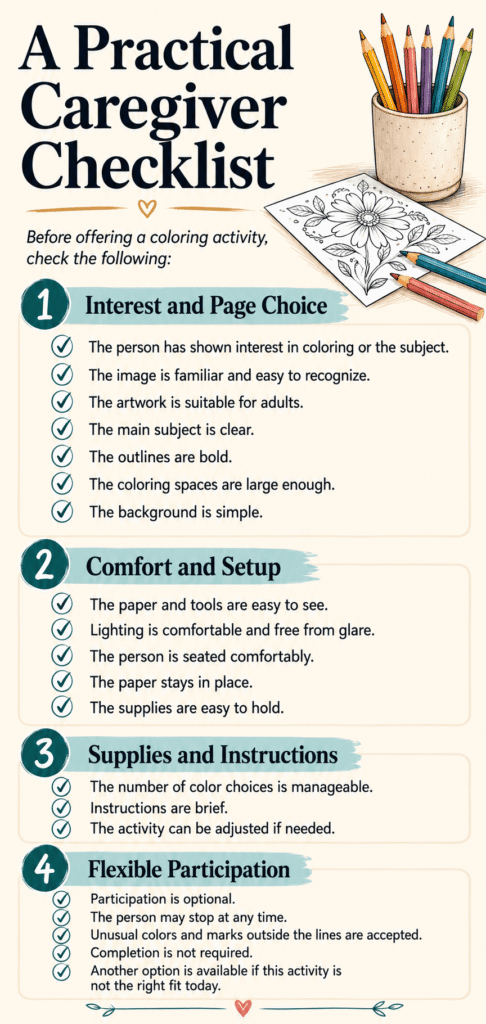
Before offering a coloring activity, check the following:
- The person has shown some interest in coloring or the subject.
- The image is familiar and easy to recognize.
- The artwork is suitable for adults.
- The main subject is clear.
- The outlines are bold.
- The coloring spaces are large enough.
- The background is simple.
- The paper and tools are easy to see.
- Lighting is comfortable and free from glare.
- The person is seated comfortably.
- The paper stays in place.
- The supplies are easy to hold.
- The number of color choices is manageable.
- Instructions are brief.
- Participation is optional.
- The person may stop at any time.
- Unusual colors and marks outside the lines are accepted.
- Completion is not required.
- The activity can be adjusted if needed.
- Another option is available if this one is not the right fit today.
Final Guidance for Caregivers
Coloring is one possible activity among many. Its value depends on whether the individual finds it interesting, comfortable, and fitting for that particular day.
Choose familiar subjects, clear pages, and tools that are easy to use. Offer only a few choices at first. Give one instruction at a time, and allow the person to participate in whatever way suits them.
Do not measure success by how much of the page is completed. Choosing a color, making a few marks, talking about the image, or sitting beside someone who is coloring can be more than enough.
Some sessions will go well. Others will end quickly or not really begin at all. That is not a failure on anyone’s part. Adjust when you can, stop when you need to, and move to something else when it fits better.
The person’s dignity, comfort, interests, and freedom to choose should guide every session from start to finish.