This article provides general educational information and is not a substitute for medical advice, diagnosis, or treatment. Consult an appropriately qualified healthcare professional about individual concerns.
Animals make a naturally flexible theme for activity programming. Depending on the person’s interests, an activity might center on pets, birds, farm animals, woodland creatures, marine life, or local wildlife. Some people have spent a lifetime with dogs underfoot. Others could watch birds for an hour without a word. Others still have no particular attachment to animals at all, which is equally worth knowing.
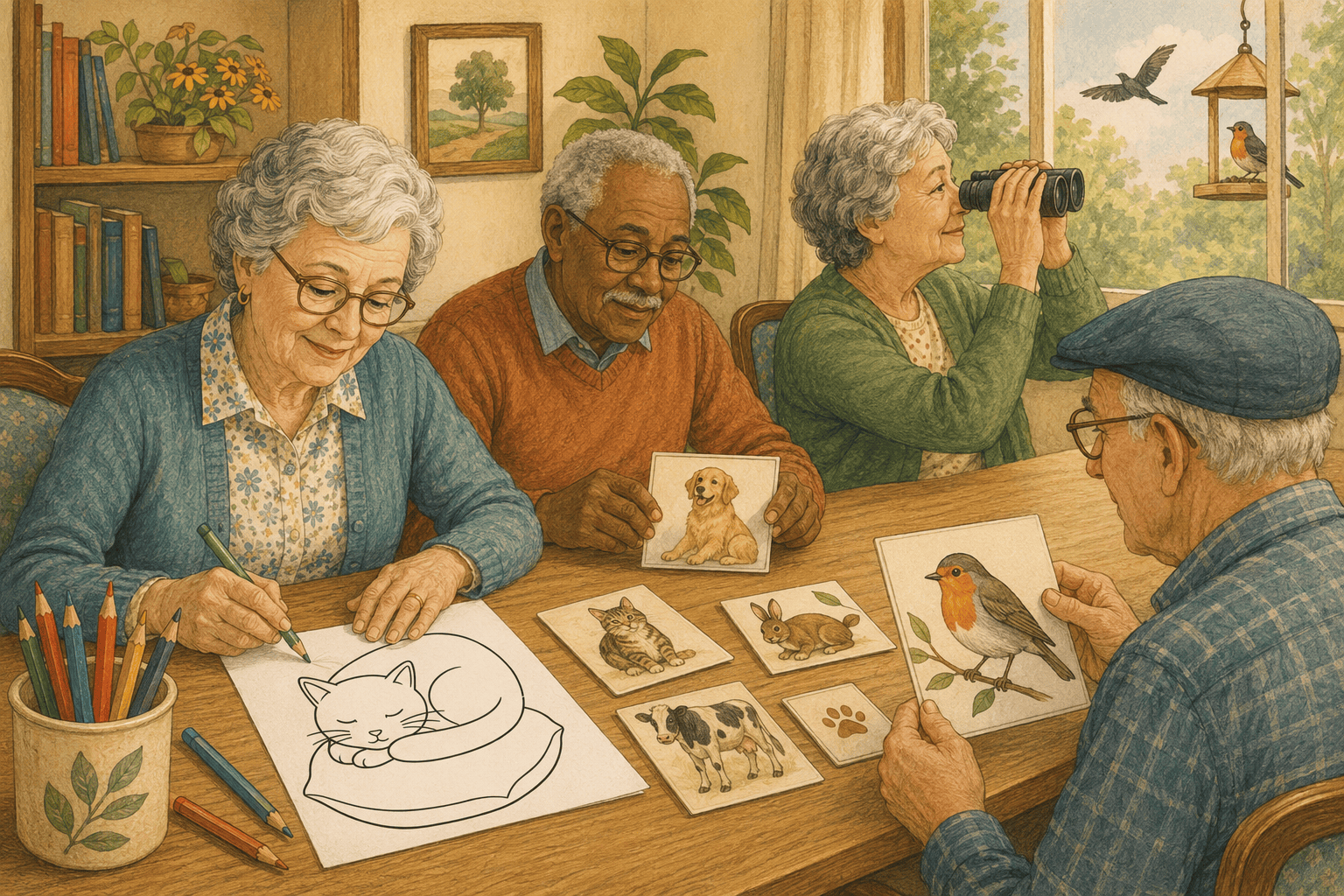
These nine activities can be adapted for independent use, one-to-one visits, or group programs. A person might color, match pictures, listen to sounds, watch birds outside a window, sort cards, answer a question, or simply sit nearby and observe. Any of those is a legitimate way to participate.
Preferences and past experiences vary more than most activity guides acknowledge. Some animals bring comfort. Others bring discomfort or difficult memories. No activity is the right fit for every person, so begin with the individual rather than the activity label.
What Makes an Animal Activity Easy to Adapt?
Adaptable animal activities tend to share a few things: familiar subjects, one clear task, simple instructions, manageable materials, and flexible ways to participate. They do not rely on scoring, competition, or time pressure.
The best choice depends on the person’s interests, vision, hearing, mobility, dexterity, reading ability, energy, and preferred level of assistance. Use all of those factors, not just the activity’s label.
Key point: Choose an activity because the animal or format genuinely interests the person, not simply because it is listed under seniors or memory care.
How to Choose a Suitable Animal Activity
Start with the person’s background and preferences rather than a list. Ask yourself whether they have always kept pets, spent time outdoors, worked with farm animals, or shown interest in nature programs. Consider what they have found calming or enjoyable in the past.
Also think about:
- Vision and contrast needs
- Hearing and sensitivity to sound
- Dexterity and grip comfort
- Mobility and seating
- Reading ability
- Attention and energy on that particular day
- Comfort in a group setting
- Preferred level of support
Offer one or two choices rather than a long menu. Use familiar, clearly recognizable, adult-appropriate pictures and simple materials.
Avoid frightening images, complicated rules, timed tasks, and worksheets that feel more like a quiz. Always allow the participant to watch, listen, pass, change activities, or stop.
The National Institute on Aging provides useful guidance on how to adapt activities to the person’s interests and abilities. Coloring Willow’s guide to choosing adaptable coloring activities for adults living with dementia also covers how page design, materials, and facilitator support can affect participation.
1. Color Familiar Animal Pictures
Coloring a single recognizable animal, a cat, dog, horse, bird, rabbit, deer, or farm animal, gives people something clear to start with. The image should have bold outlines, large open spaces, limited overlap, and minimal background detail. You can read more about what those features look like in practice in this guide to large-print coloring page design.
Prepare printed pages and a small selection of crayons, colored pencils, or broad-tip markers. Place protective paper beneath the page when using markers.
For a simpler setup, offer one or two pages at a time. Choose designs with broad coloring spaces and only demonstrate a single mark if support seems helpful, not to show the person how it should look.
Participation may take many forms:
- Coloring independently or alongside someone
- Choosing which colors to use
- Naming or discussing the animal
- Watching someone else color
- Coloring only one section of the picture
Match the tools to the person’s grip comfort. Secure the paper if it moves. Check that the printed lines remain dark and clear before handing the page over.
Coloring Willow also offers simple animal coloring pages for seniors and memory care with familiar subjects and bold, open designs.
2. Match Animal Pictures
Matching works well because it requires recognition and choice without demanding recall. Create a matching activity using identical animal pictures, adult animals paired with their young, or animals paired with familiar homes and habitats. Use realistic, clearly differentiated images rather than exaggerated cartoon characters.
Print the pictures on cardstock and cut the cards before the activity starts. A nonslip mat helps keep them in place. You can also mark two areas on the table where matching cards should be placed, which reduces the need for verbal explanation.
For a dementia-friendly version, begin with two or three clearly different pairs. Keep every card face up. Start by matching identical pictures before moving to relationships like an animal and its habitat.
Participants may point to matching pictures, place cards together, name the animals, or work alongside a facilitator. Use cards that are large enough to see and grasp comfortably. Avoid small loose pieces when they could present a safety concern. There is no need to score anything or correct every placement.
3. Share Pet and Animal Reminiscence Prompts
A photograph of a familiar animal can open conversation without requiring anyone to remember a specific name, date, or detail. Use one or two large images featuring pets, birds, farm animals, wildlife, or animals from everyday surroundings.
Possible prompts include:
- “Were animals part of your home or neighborhood growing up?”
- “What kinds of birds do you enjoy seeing?”
- “Is there an animal you have always liked?”
- “What do you notice in this picture?”
These questions are open-ended by design. They invite stories, preferences, and observations without putting anyone on the spot.
Present one photograph and one question at a time. Accept a brief comment, gesture, smile, observation, or a decision to pass. The activity works well during a one-to-one visit or in a small group where participants listen and contribute as they feel comfortable.
Do not assume that memories involving animals are uniformly positive. If a picture or prompt appears to cause discomfort, acknowledge the response and simply move to something else.
4. Watch Birds From a Window or Outdoor Area
Birdwatching can be as simple as finding a comfortable chair near a window and noticing what flies past. A porch, courtyard, garden, or other accessible outdoor space works just as well.
The key is comfortable seating and a clear view. Binoculars, a large-print local bird sheet, a notebook, or a picture checklist can all be offered, but none of them is essential. The activity does not require naming a single species correctly.
Focus on observation:
- “What color do you notice?”
- “Is the bird on the ground or in the tree?”
- “Is it moving or resting?”
- “Can you hear anything?”
A participant may watch silently, point, describe movement, listen, or talk about birds they remember from another part of their life. The activity can last a few minutes or continue for as long as interest holds.
Before going outdoors, check pathways, seating, glare, temperature, weather, and supervision. Make binoculars optional, since they can be genuinely difficult to position and focus. The Cornell Lab of Ornithology offers optional bird identification and observation resources for anyone who wants to go further.
5. Play an Animal Sound Identification Activity
Use a phone, tablet, computer, or portable speaker to play short recordings of familiar animals. A dog, cat, horse, cow, sheep, rooster, owl, or common local bird can all work well. Prepare and label the clips in advance, and confirm that each recording represents the intended animal.
Play one sound at a time. When visual cues may help, place two large animal pictures in front of the participant and ask, “Which animal might make this sound?”
Participation may include naming an animal, pointing to a picture, imitating the sound, sharing an observation, or simply listening. A correct answer is not required, and the activity should not feel like one is required.
Check the volume before beginning. Avoid sudden, harsh, repetitive, or frightening recordings. Consider hearing aids and individual sensitivity to sound. If a recording appears to cause discomfort, stop, lower the volume, or simply move on.
6. Answer Familiar Animal Trivia
Animal trivia can work well during a one-to-one visit or as part of a group activity program. Use clear, conversational questions about familiar pets, birds, farm animals, and widely recognized animal characteristics. Keep the tone more like a discussion than an exam.
Offer two or three answer choices, read questions aloud when helpful, and include large picture cues when appropriate.
Participants may answer aloud, point to a choice, discuss the animal, listen to other responses, or pass. Group answers and gentle facilitator hints can shift the activity toward something collaborative rather than individual.
Avoid trick questions, obscure scientific names, alarming facts, and any content involving predators or animal harm in distressing detail. Do not emphasize scores or publicly correct someone in front of a group.
Every question and answer should be checked against a reliable reference. Review the answer key separately, after the activity is complete, to confirm that numbering and wording match up.
7. Sort Animals by Type or Habitat
Sorting combines visual recognition, handling, gentle decision-making, and conversation. Prepare several large animal picture cards and two clearly labeled areas on the table, such as mats, trays, or marked zones.
Possible categories include:
- Pets and farm animals
- Birds and mammals
- Land animals and water animals
- Animals seen locally and animals from elsewhere
For a simpler version, start with two clearly different categories and four to six cards. Demonstrate the placement of the first card if that would help clarify the activity without overstating it.
Participants may sort cards, point to a category, name an animal, explain their reasoning, or work together with another person. Some categories will allow more than one reasonable interpretation, and accepting those interpretations can keep things conversational rather than corrective.
Use large cards with strong contrast. Keep the table clear of unrelated materials. Do not score the results or draw attention to mistakes.
8. Complete an Animal-Themed Word Search
Word searches can suit people who enjoy quiet, paper-based activities and familiar vocabulary. Themes might include pets, birds, farm animals, woodland animals, or animals by the sea.
Prepare the printed puzzle, a pencil or highlighter, and a separate answer key for the facilitator.
For a more accessible version:
- Use a small grid, around 10 by 10
- Include six to ten familiar words
- Use large, clearly spaced letters
- Keep words horizontal at the simplest level
Read the word list aloud or locate the first word together when support may help. A participant can work independently, search with a partner, point to individual letters, listen to the list being read, or circle words with assistance.
Avoid dense grids, small print, backward words, and diagonal words in the simplest version. Print a sample before the activity to confirm the letters and grid remain clear. Finishing every word is optional.
9. Create a Simple Bird or Animal Collage
A collage allows participants to make visual choices without needing to draw, recall specific facts, or follow a sequence of steps. Use several large, pre-cut animal pictures to create an individual page, a group poster, or a seasonal display.
Possible themes include:
- Garden birds
- Favorite pets
- Farm animals
- Woodland animals
- Animals by the sea
Provide cardstock or poster paper, glue sticks, and a limited selection of clearly different pictures. Simple labels or large background shapes can be added when they support the theme.
A participant might select pictures, arrange them on the page, name animals, talk about preferences, apply glue, or contribute a single image to a group collage. When preferred, the participant can choose and position each piece while the facilitator handles the adhesive.
Consider dexterity, sensitivity to adhesives, and whether scissors are appropriate. Pre-cut the images when scissors are unsuitable. Avoid glitter, small decorative pieces, and layouts that become too busy to navigate.
For a coordinated bird theme, pages from Coloring Willow’s bold-line bird coloring pages for seniors can provide additional visual inspiration or a separate coloring activity alongside the collage.
Frequently Asked Questions
What animal activities work well in memory care?
Activities with one clear task and familiar subjects tend to be the most approachable for some memory care participants. Matching two identical animal pictures, coloring one familiar animal, watching birds, listening to a single sound, or sorting a few large cards can all work well depending on the person.
Choose the subject based on the person’s interests and comfort. Limit the materials, keep instructions brief, and allow pointing, listening, observing, speaking, or passing as equally valid forms of participation. Individual needs and responses vary considerably.
How can I adapt an animal activity for someone who does not write?
Writing is not required. The person may point to a picture, answer aloud, listen to animal sounds, watch birds, arrange cards, select a color, imitate a sound, or choose an image for a collage.
A facilitator can read questions aloud, hold materials steady, or offer one-to-one support throughout. Use whichever response method feels most comfortable for the participant.
Are live animal visits appropriate for every senior group?
No. Live animal visits require separate planning and are not suitable for every individual or setting.
Consider participant consent, allergies, fear of animals, animal temperament, handler qualifications, hygiene procedures, mobility, fall risk, and facility policies before arranging one. Every person should always be able to decline the visit or remain at a comfortable distance without pressure.
What if a participant does not like animals?
Animal activities should always be optional. Some people have little interest in animals, while others may have fears or difficult associations.
Choose another familiar theme, such as gardening, cooking, music, transportation, travel, crafts, or favorite hobbies. The most suitable activity is always the one based on personal interest, not the general popularity of a topic.
How can I keep animal trivia from feeling like a test?
Use familiar questions, two or three answer choices, picture cues, and group responses. Present each question as an opportunity for conversation rather than a measure of what someone knows.
Allow participants to listen or pass without comment. Avoid scoring, trick questions, speed rounds, and public correction. When someone gives an unexpected answer, acknowledge it and move naturally into discussion or the next question.
Final Thoughts About Animal Activities for Seniors and Memory Care
Animal themes can support many different forms of participation: coloring, watching, listening, matching, sorting, crafting, and simple conversation. The best activity is always the one that fits the person’s interests, abilities, sensory preferences, support needs, and energy on that particular day.
Participation does not require completing a page, giving a correct answer, or finishing anything at all. Begin with one simple activity, watch how the person responds, and adjust the format or materials from there.
You can also browse sample pages from Coloring Willow’s animal and bird coloring collections to consider whether the subjects, linework, and level of detail are a good fit for the individual or group you support.
Free Coloring Pages From Coloring Willow
Looking for more printable coloring pages? Coloring Willow offers a free collection of coloring page PDFs that you can access without signing up for an email list.
The free folder includes flower coloring pages, rose coloring pages, sunflower coloring pages, daisy coloring pages, and bold-and-easy object coloring pages. Print one page or choose several to use at home, during family visits, in senior centers, or in assisted living and memory care settings.
You can access the free coloring pages here.
If you find these pages helpful, please consider sharing this article on social media so other caregivers, families, activity directors, and older adults can find them too.
For more printable coloring pages and activity packs, visit the Coloring Willow Etsy shop.